Kanye West’s Most Controversial Moments Ranked: The $2 Billion Cost of Chaos
May 5, 2026
 kanye_1.jpg” alt=”Kanye West Most Controversial Moments Ranked — Financial Impact” width=”1344″ height=”768″ />
Kanye West’s Most Controversial Moments Ranked: The $2 Billion Cost of Chaos
Kanye West (now known as Ye) lost an estimated $2 billion in net worth from controversies spanning 2009 to 2026. The single costliest moment — his October 2022 antisemitic tirade — triggered Adidas to terminate a $1.5 billion deal, Gap to end a $970 million partnership, and Balenciaga, Def Jam, and MRC to cut ties simultaneously, dropping his net worth from $2 billion to $400 million overnight.
Despite the staggering financial damage, Ye claims his current net worth is $2.77 billion based on music catalog valuation and sole ownership of the Yeezy mark — a figure Forbes disputes. The gap between Ye’s self-valuation and independent estimates represents one of the widest discrepancies in celebrity wealth tracking history.
Quick Facts: Kanye West Controversy Financial Impact
| Category | Details |
|---|---|
| Peak Net Worth | $2B (2022, Forbes) |
| Current Net Worth (Forbes) | $400M (2026–2026) |
| Biggest Single Loss | $1.5B (Adidas deal termination) |
| Total Estimated Losses | $2–6B (valuation dependent) |
| Brands Lost | Adidas, Gap, Balenciaga, Def Jam, MRC |
| UK Ban Status (2026) | Banned — Wireless Festival cancelled |
#1: The 2022 Antisemitic Tirade — $1.6 Billion Gone in One Day
On October 8, 2022, Ye posted on Twitter: “I’m going death con 3 On JEWISH PEOPLE.” The fallout was immediate and catastrophic. Within 72 hours, Adidas terminated its Yeezy partnership — a deal worth an estimated $1.5 billion to Ye personally. Gap ended its ~$970 million partnership. Balenciaga cut ties. Def Jam severed its relationship. Documentary studio MRC shelved a completed documentary.
Ye later posted on Instagram: “I lost $2 billion in one day.” The figure was directionally accurate — Forbes revised his net worth from $2 billion to $400 million within days, removing him from the billionaires list entirely. The Adidas termination alone accounted for $1.5 billion of the loss, as Yeezy footwear generated an estimated $1.7 billion in annual revenue for the brand.
For perspective on celebrity wealth, see the richest Hollywood actors of 2026 — many earn more per year than Ye’s entire remaining net worth.
#2: “White Lives Matter” Shirt at Paris Fashion Week (October 2022)
Days before the antisemitic tweets, Ye wore a “White Lives Matter” shirt at his Yeezy Season 9 fashion show during Paris Fashion Week. The stunt alienated Vogue and Anna Wintour, who distanced the publication from Ye after years of featuring him prominently. The shirt controversy served as a prelude to the larger antisemitic incident that followed, compounding the brand damage.
Financial impact is harder to isolate from the subsequent antisemitic tirade, but fashion industry insiders estimate the “White Lives Matter” incident alone cost Ye $50–$100 million in future fashion partnerships that were in preliminary discussion stages. Brands that had been considering Yeezy collaborations pulled out of talks permanently.
#3: 2026 X (Twitter) Meltdown — “I Am a Nazi” and Swastika T-Shirt
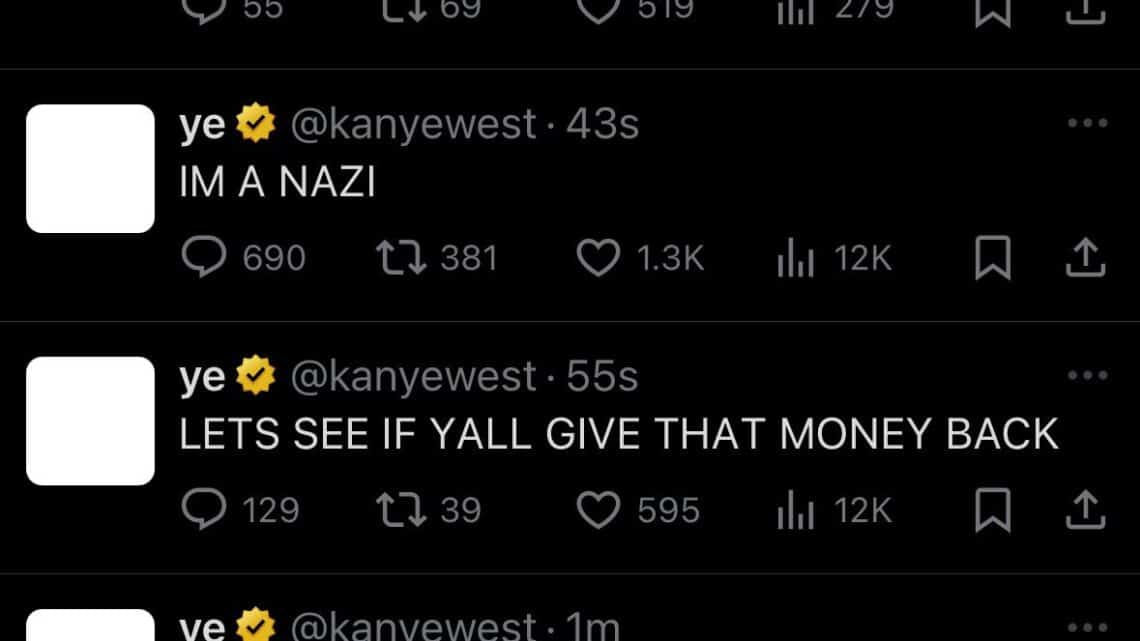
In February 2026, Ye launched another antisemitic tirade on X, declaring “I am a Nazi” and “I love Hitler.” He simultaneously began selling a swastika T-shirt on Yeezy.com. The response was swift: his talent agency dropped him, a former Yeezy staffer sued him, retail platforms pulled Yeezy.com, and Shopify suspended his online store.
The 2026 incident was particularly damaging because it proved the 2022 antisemitic remarks weren’t a one-time lapse but a pattern. Brands that had been quietly open to future Yeezy partnerships — hoping the 2022 incident would fade — permanently closed the door. Industry sources estimate the 2026 tirade cost an additional $100–$200 million in potential partnership revenue.
#4: “Slavery Was a Choice” — TMZ Live (May 2018)
Ye‘s 2018 appearance on TMZ Live, where he stated “slavery was a choice,” generated massive public backlash but surprisingly limited financial damage at the time. Sponsors reportedly reconsidered their relationships, but no major brand terminations occurred immediately. The incident did, however, begin eroding the corporate goodwill that would later collapse entirely in 2022.
The long-term impact of the TMZ incident was cultural rather than financial — it shifted public perception of Ye from unpredictable genius to potentially dangerous provocateur. This shift in reputation made later brand terminations easier for companies facing public pressure, as executives could point to a pattern of controversial behavior rather than a single incident.
#5: VMA Interruption — “Imma Let You Finish” (September 2009)
The incident that started it all: Ye interrupting Taylor Swift‘s 2009 MTV VMA acceptance speech to declare that Beyoncé had “one of the best videos of all time.” The moment became instant pop culture history, spawning memes, think pieces, and a decade-long feud between Ye and Swift.
Financially, the VMA interruption caused no direct losses — Ye‘s career actually benefited from the attention in the short term. Album sales for 808s & Heartbreak increased in the weeks following the incident. However, the moment established a pattern of public disruption that would escalate dramatically in subsequent years, ultimately contributing to the brand liability that cost him billions.
Complete Controversy Timeline and Financial Impact
| Date | Incident | Est. Financial Impact |
|---|---|---|
| Sep 2009 | VMA interruption | $0 (career benefited) |
| Nov 2013 | Confederate flag merch | Minimal |
| Feb 2016 | “Famous” Taylor Swift lyrics | $0 direct |
| May 2018 | “Slavery was a choice” | Minimal (erosion began) |
| 2018–19 | Pro-Trump/MAGA statements | Some fan erosion |
| Oct 2022 | Antisemitic tirade + Adidas loss | $1.6B+ |
| Oct 2022 | “White Lives Matter” shirt | $50–$100M |
| Feb 2026 | “I am a Nazi” + swastika shirt | $100–$200M |
| Apr 2026 | UK ban / Wireless Festival cancelled | $10M+ touring revenue |
The Yeezy Brand: What Ye Still Owns
Despite losing the Adidas partnership, Ye retains sole ownership of the Yeezy trademark — the most valuable asset in his remaining portfolio. Without Adidas as a manufacturing and distribution partner, Yeezy operates as a direct-to-consumer brand with limited retail presence but full profit margins on every sale. The question isn’t whether Yeezy has value — it’s how much value remains without corporate infrastructure behind it.
Before the Adidas split, Yeezy generated $1.7 billion in annual revenue for Adidas, with Ye receiving royalties estimated at 5-15% of sales. Post-split, Adidas sold approximately $500 million in remaining Yeezy inventory through 2023-2024, with the financial terms of Ye’s cut from this liquidation undisclosed. The inventory sale represented the final chapter of the Adidas-Yeezy relationship.
Going forward, Yeezy as an independent brand faces significant challenges. Manufacturing quality, distribution logistics, and retail partnerships all require corporate expertise that Ye must now either build internally or outsource. However, the brand’s cultural cachet remains strong — Yeezy products continue to command premium resale prices on secondary markets, suggesting that consumer demand hasn’t evaporated despite the controversies. If Ye can execute a credible relaunch, annual revenue of $200-500 million is achievable within three years.
Career Timeline: The Arc From Producer to Billionaire to Outcast
Understanding Ye’s financial trajectory requires tracing the full arc of his career. Born Kanye Omari West on June 8, 1977, in Atlanta, Georgia, and raised in Chicago, he first gained recognition as a producer for Roc-A-Fella Records in the early 2000s, crafting hits for Jay-Z, Alicia Keys, and Ludacris before convincing label executives to let him release his own music. His debut album The College Dropout (2004) sold 441,000 copies in its first week and went on to achieve triple platinum status, establishing him as both a critical and commercial force.
The albums that followed — Late Registration (2005), Graduation (2007), 808s & Heartbreak (2008), My Beautiful Dark Twisted Fantasy (2010), Yeezus (2013), The Life of Pablo (2016), Ye (2018), and Donda (2021) — collectively sold over 50 million albums worldwide and earned him 24 Grammy Awards, making him one of the most decorated artists in Grammy history. His production innovations, particularly the “chipmunk soul” technique of speeding up vocal samples, influenced an entire generation of hip-hop producers.
The Yeezy brand launched in February 2015 with the Yeezy Boost 750 sneaker, a collaboration with Adidas that initially produced 9,000 pairs selling for $350 each. By 2022, Yeezy had grown into a $1.7 billion annual business, representing roughly 8% of Adidas’s total revenue. The brand’s success was unprecedented in celebrity fashion partnerships — no other entertainer had built a footwear empire that generated comparable revenue. At peak, Yeezy was adding an estimated $150–200 million annually to Ye’s personal wealth through royalties and equity appreciation.
The Gap deal, announced in June 2020, was a 10-year agreement worth a reported $970 million, with Ye receiving stock warrants and royalties. The partnership produced the Yeezy Gap line, including the viral round jacket that sold out within hours of its release. However, the relationship deteriorated amid disputes over creative control and distribution strategy, and Gap terminated the deal in September 2022 — weeks before the antisemitic tirade that would collapse the rest of Ye’s corporate partnerships.
Music Catalog Valuation: The Remaining Asset
Ye’s music catalog represents his most stable remaining asset, valued at approximately $100–225 million depending on the valuation methodology. The catalog includes publishing rights and master recording royalties across his entire discography, which spans 11 studio albums and hundreds of individual tracks. Key revenue generators include streaming royalties (his catalog averages approximately 40 million monthly listeners on Spotify alone), synchronization licensing for film and television placements, and sample clearance fees from other artists who use his compositions.
In 2023, following the Adidas split, reports emerged that Ye was shopping his music catalog for sale at approximately $175 million — a figure that industry analysts considered below market value for a catalog of his stature, suggesting financial pressure. No sale materialized publicly, meaning Ye retains ownership and the associated income stream. Annual publishing and recording royalties from the catalog are estimated at $5–8 million, providing a financial floor that keeps him wealthy by any standard, even as his brand partnerships have evaporated.
The catalog’s long-term value depends partly on cultural rehabilitation. Music catalogs are valued based on projected future earnings, and if Ye’s controversies continue to reduce sync licensing opportunities (filmmakers and advertisers avoiding association with his music), the catalog’s income potential could decline over time. Conversely, if his music remains popular on streaming platforms regardless of personal controversies — as has been the case with other controversial artists — the catalog could maintain or increase its value as streaming rates rise industry-wide.
Financial Comparison: Ye vs. Other Controversial Celebrities
Ye’s $2 billion loss is without precedent in modern entertainment history, but comparing his situation to other controversial figures provides useful context. Mel Gibson, whose 2006 antisemitic rant during a DUI arrest and 2010 recordings of abusive language derailed his career, saw his net worth decline from an estimated $850 million to approximately $425 million — a roughly 50% decline. Gibson has since partially rebuilt his career through directorial projects including Hacksaw Ridge (2016), but he never returned to his earning peak.
Bill Cosby, convicted of sexual assault in 2018 (later overturned on procedural grounds in 2021), saw his estimated $400 million net worth decimated by legal fees, settlements, and the cancellation of residual income from The Cosby Show. Cosby’s financial decline was more total than Ye’s — he lost virtually all income streams — but the absolute dollar amount was smaller because his pre-controversy net worth was lower.
J.K. Rowling presents an inverse comparison. Despite facing sustained backlash over her statements on gender identity since 2019, the Harry Potter author’s net worth has remained largely unaffected at approximately $1 billion, because her income comes from book royalties and theme park licensing rather than brand partnerships that can be terminated. The lesson for Ye: diversified, uncontrollable income streams (like book royalties or music publishing) are more controversy-proof than corporate partnerships that depend on brand reputation.
Legal Costs and Litigation Exposure
Controversies don’t just cost revenue — they generate enormous legal expenses. Ye’s legal bills between 2022 and 2026 are estimated at $20–40 million, covering defense against multiple lawsuits, contract disputes with former business partners, and intellectual property litigation. Former Yeezy employees have filed suits alleging unpaid wages and hostile work conditions, and the Adidas separation itself required extensive legal negotiation over trademark rights, inventory, and outstanding financial obligations.
The 2026 “I am a Nazi” incident generated additional litigation exposure. A former Yeezy staffer filed suit alleging a hostile work environment, and the swastika T-shirt sales prompted investigations by European authorities under hate speech laws. Each new legal matter requires retainers, discovery costs, and potentially settlement payments that erode Ye’s remaining assets. Unlike corporate partnerships that produce a single discrete financial loss, legal exposure is ongoing and unpredictable — a $5 million verdict in a single case could materialize at any time.
Cultural Impact: How Ye’s Controversies Changed Brand Partnerships
The Ye-Adidas split had ripple effects across the entire celebrity-brand partnership landscape. In the aftermath, corporate boards and brand executives adopted what industry insiders call the “Ye Clause” — morality provisions in endorsement and partnership contracts that allow immediate termination without financial obligation if a celebrity engages in conduct that damages the brand’s reputation. Before 2022, such clauses existed but were rarely invoked; after Adidas demonstrated that terminating a $1.5 billion deal was both legally feasible and commercially necessary, brands became far more aggressive in protecting themselves.
The shift is quantifiable. A 2024 analysis by the sports marketing firm Octagon found that morality clause provisions in athlete and entertainer contracts had become 40% more specific and 60% more enforceable since 2022, with brands explicitly listing categories of conduct (including hate speech, criminal behavior, and political extremism) that trigger automatic termination. The “Ye precedent” gave corporate legal teams a concrete case study to cite in negotiations, tilting the balance of power toward brands in partnership agreements.
For consumers, the Yeezy-Adidas saga also changed how purchases are evaluated. The secondary market for Yeezy sneakers initially spiked after the Adidas termination — resale prices for certain models increased 30–50% as collectors anticipated scarcity — before gradually declining as the cultural moment faded. The brand’s trajectory illustrates a broader pattern in celebrity commerce: controversy can generate short-term demand through scarcity and notoriety, but sustained commercial success requires ongoing distribution and innovation that individual celebrities rarely manage alone.
Philanthropy and Charitable History
Before his controversies, Ye maintained a charitable record that included the Kanye West Foundation, established in 2003 by his late mother Donda West to support education and arts programs in Chicago. The foundation, which focused on reducing dropout rates through music and fashion education, reportedly distributed over $1 million in grants before dissolving in 2011 after Donda West’s death in 2007. Following her passing, Ye established the Donda’s House organization in 2013, though its operations were limited and it faced criticism for transparency issues.
Ye has made individual donations to various causes over the years, including a reported $2 million contribution to the families of George Floyd, Ahmaud Arbery, and Breonna Taylor in 2020, and donations to hurricane relief efforts. However, his philanthropic efforts have been eclipsed by his controversies, and the 2022-2026 incidents have made charitable organizations reluctant to accept donations from him publicly. The result is a figure whose capacity for positive impact through philanthropy has been severely constrained by the same behavior patterns that destroyed his corporate partnerships.
Future Projections: Can Yeezy Survive Without Corporate Partners?
The central question for Ye’s financial future is whether Yeezy can generate meaningful revenue as a standalone brand without the manufacturing, distribution, and retail infrastructure that Adidas and Gap provided. The most comparable case is Victoria Beckham’s fashion label, which launched in 2008 and struggled for years before achieving profitability in 2018 — a decade-long journey that required sustained investment and industry expertise. Ye lacks the fashion industry credibility and operational discipline that Beckham developed over that period.
Direct-to-consumer sales through Yeezy.com remain the primary channel, but e-commerce alone cannot replicate the scale of retail partnerships that once placed Yeezy products in thousands of stores worldwide. Industry analysts estimate that Yeezy’s annual revenue as an independent brand in 2026 is approximately $20–50 million — a fraction of the $1.7 billion generated under the Adidas partnership. At those levels, and with manufacturing costs eating into margins that Adidas formerly subsidized, Ye’s annual income from Yeezy likely ranges from $5–15 million — enough for a comfortable lifestyle but nowhere near the wealth generation of his peak years.
A cultural rehabilitation scenario — unlikely given the 2026 “I am a Nazi” incident but not impossible over a long enough timeline — could potentially attract a second-tier brand partnership that generates $100–200 million in annual revenue. However, no major global brand will risk association with Ye in the current environment, and rehabilitation would require years of consistent, controversy-free behavior that Ye has never demonstrated the capacity to sustain.
For more insights, see our coverage of Inside Kanye West’s Minimalist Living Spaces (2026): Net Worth, Properties & Design.
For more insights, see our coverage of Most Influential Celebrities of 2026 Ranked.
Related Articles
- Why Logan Paul Can’t Shake His Biggest Scandals
- The Danny Phantom Lawsuit Explained: Creator vs. Nickelodeon
- Colleen Ballinger Controversy Timeline: How It All Fell Apart
Frequently Asked Questions
How much money did Kanye West lose from controversies?
Kanye West lost an estimated $2–6 billion from controversies, depending on valuation methodology. The largest single loss was the $1.5 billion Adidas deal termination in October 2022, followed by Gap’s ~$970 million partnership ending.
What is Kanye West’s net worth in 2026?
Forbes estimates Ye’s net worth at $400 million. Ye himself claims $2.77 billion based on music catalog and Yeezy mark valuation. The true figure likely falls between these estimates.
Why did Adidas drop Kanye West?
Adidas terminated its Yeezy partnership on October 25, 2022, following Ye’s antisemitic statements on social media. The deal was worth an estimated $1.5 billion to Ye personally and generated $1.7 billion in annual revenue for Adidas.
Is Kanye West banned from the UK?
Yes. In April 2026, Ye was banned from entering the UK over antisemitic statements. The Wireless Festival cancelled his appearance, resulting in lost touring revenue estimated at $10 million+.
Disclaimer
This article is based on publicly available information, news reports, and verified social media records. Financial figures are estimates from Forbes, Bloomberg, and industry analysts and may not reflect exact values. Net worth estimates are subject to change based on asset valuations and market conditions. The analysis represents an independent editorial perspective and should not be considered financial or professional advice. We do not claim official affiliation with Kanye West or Yeezy.